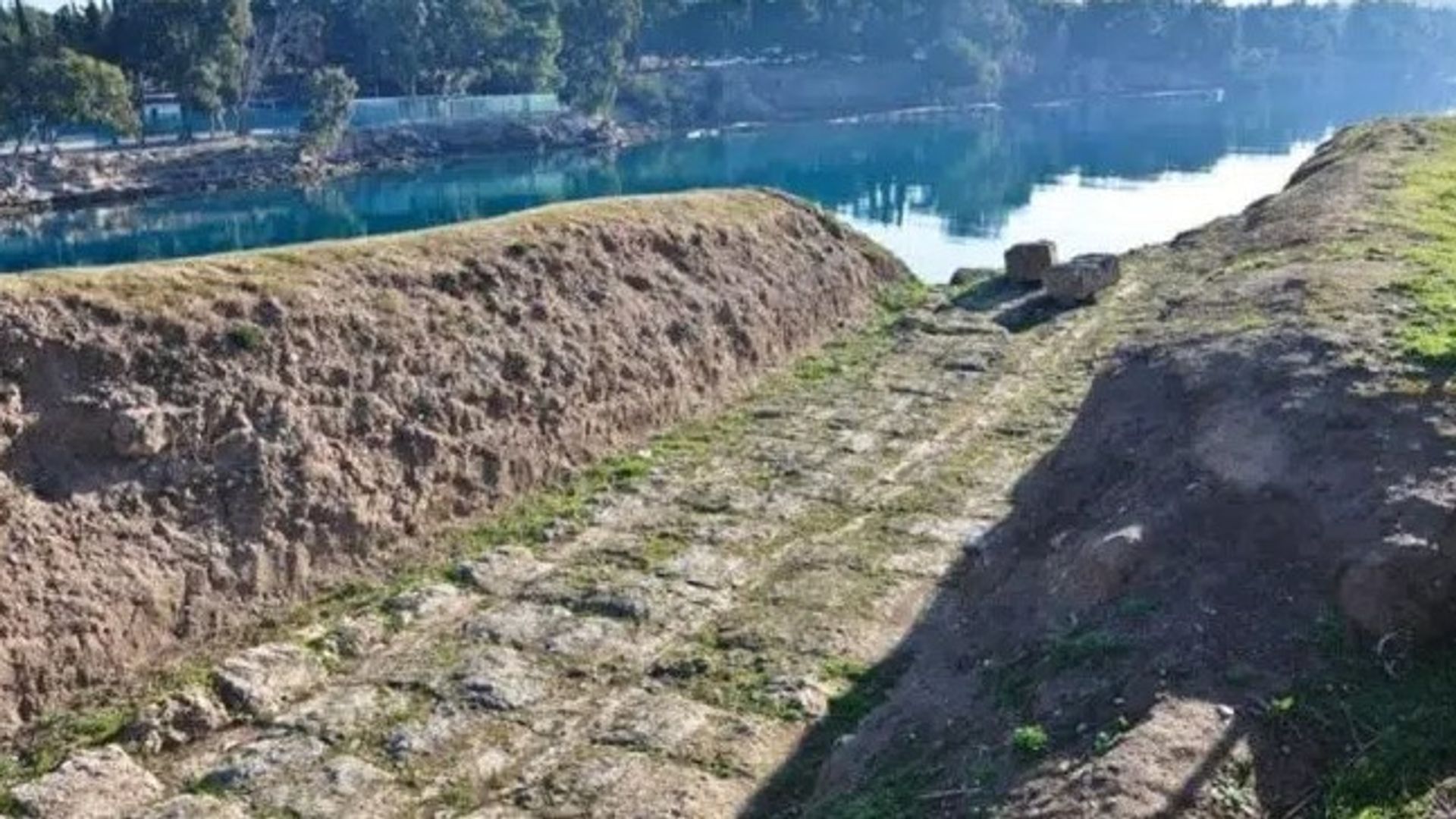
The Diolkos was an ancient paved trackway near Corinth that transported ships across the Isthmus of Corinth for over 1,300 years. This engineering marvel revolutionized maritime trade and military strategy in the ancient Mediterranean world.
Imagine dragging an entire ship across six kilometers of land to save weeks of dangerous sailing around the Peloponnese. The ancient Greeks didn't just imagine it—they built the Diolkos, a paved stone trackway that transported vessels across the Isthmus of Corinth for over thirteen centuries.
This engineering masterpiece, constructed around 600 BCE, represents one of antiquity's most ambitious infrastructure projects and a testament to Greek ingenuity.
What Was the Diolkos?
The Diolkos (meaning "haul-across" in Greek) was a sophisticated paved trackway that connected the Corinthian Gulf with the Saronic Gulf. Ships and cargo were transported across the narrow Isthmus of Corinth on wheeled platforms called holkos, avoiding the treacherous 700-kilometer voyage around the Peloponnese.
This ancient transport system operated from approximately 600 BCE until the 9th century CE, serving military, commercial, and strategic purposes throughout the Classical, Hellenistic, Roman, and early Byzantine periods.
Engineering Marvel of the Ancient World
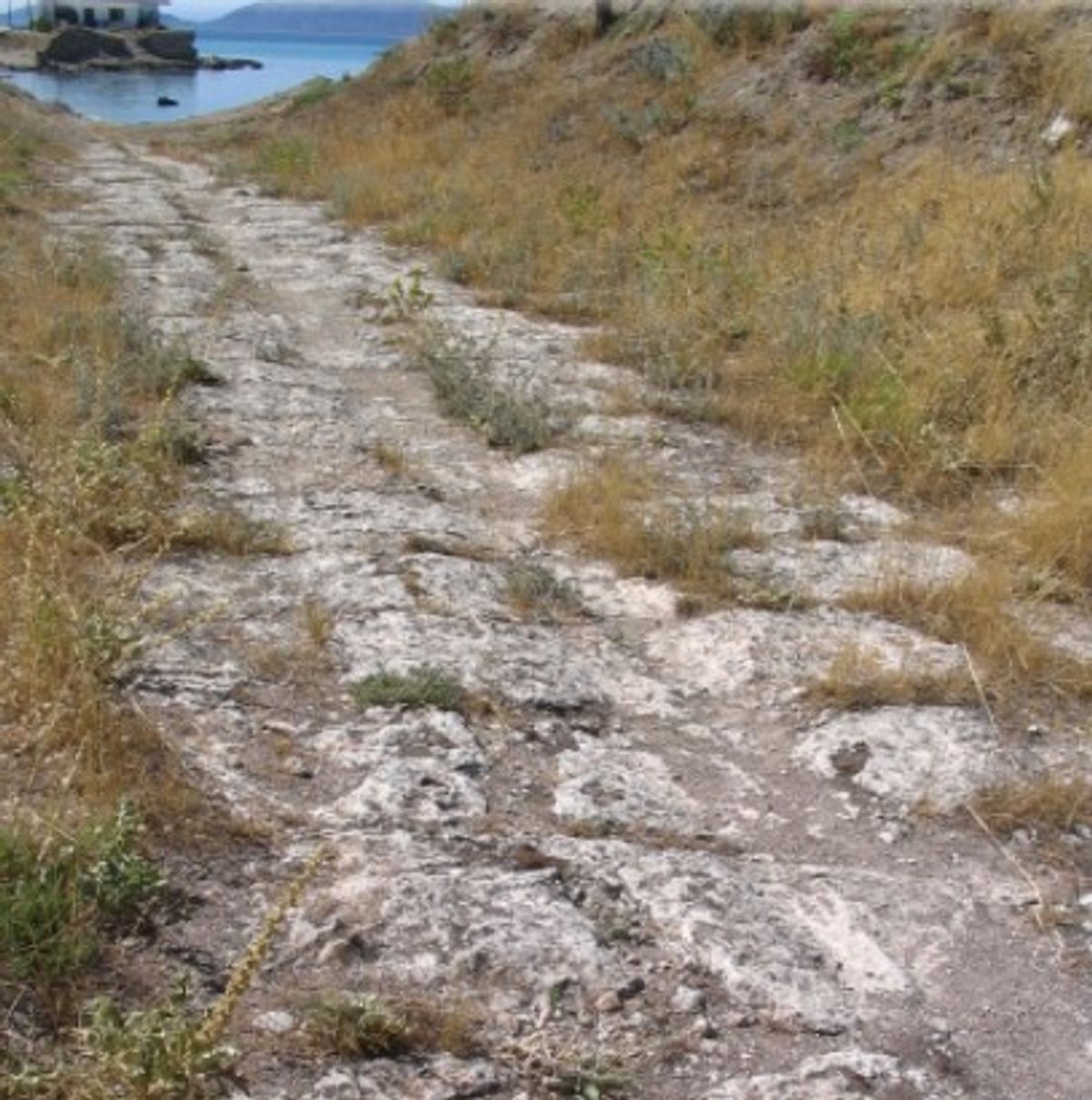
The Diolkos stretched approximately 6 to 8.5 kilometers across the narrowest part of the Isthmus of Corinth. The trackway consisted of parallel grooves carved into limestone pavement, with a standard gauge of approximately 1.5 meters between the ruts.
The ingenious design included sections with different gradients, curves with varying radii to accommodate the terrain, and sophisticated drainage systems to prevent water damage.
Technical Features:
- Paved surface made of hard limestone blocks
- Deep parallel grooves to guide wheeled vehicles
- Variable track width to accommodate different vessel sizes
- Strategic placement following the terrain's natural contours
- Switching points where tracks could diverge
- Stone curbs to prevent vehicles from derailing
The construction required precise engineering calculations and an understanding of mechanics that wouldn't be matched in Europe for another two millennia. Ancient engineers had to account for weight distribution, friction, gradient changes, and the structural integrity of both the trackway and the transport vehicles.
Historical Significance and Purpose
Corinth's strategic location made the Diolkos invaluable for both commercial and military purposes. Merchant vessels could save weeks of travel time and avoid the dangerous waters around Cape Malea, known in antiquity for shipwrecks and piracy.
Military commanders could rapidly move naval forces between the Aegean and Ionian seas, providing tactical advantages during conflicts.
Strategic Advantages:
- Reduced sailing time from weeks to approximately one day
- Avoided dangerous Cape Malea passage
- Enabled rapid military fleet deployment
- Generated substantial revenue through transit fees
- Strengthened Corinth's position as a trade hub
- Facilitated cultural and commercial exchange
The Diolkos contributed significantly to Corinth's wealth and power during the Classical period. The city charged fees for using the trackway, creating a steady revenue stream that helped finance magnificent architectural achievements throughout the region.
How Ships Were Transported
The transportation process required sophisticated logistics and considerable manpower. Ships were either kept in the water and pulled on wheeled cradles, or smaller vessels were lifted entirely onto transport platforms.
The holkos—wooden platforms with wheels designed to fit the trackway grooves—carried vessels across the isthmus using teams of slaves, animals, or mechanical winches.
Transportation Process:
- Ships arrived at either the eastern or western terminus
- Vessels were secured to wheeled transport platforms (holkos)
- Teams of workers or animals pulled the platforms along the grooved trackway
- Cargo might be unloaded for separate transport to reduce weight
- Ships were launched at the opposite gulf
- The entire crossing typically took one to two days
Historical accounts suggest that even warships with crews of 170 rowers could be transported across the Diolkos. The system could accommodate vessels up to approximately 30 tons, though estimates vary among archaeologists.
Archaeological Discovery and Preservation
The Diolkos remained largely forgotten until its rediscovery in the 19th century. British archaeologists first identified sections of the trackway in the 1830s, but systematic excavation didn't begin until the 20th century.
Today, several well-preserved sections are visible near the modern Corinth Canal, offering tangible evidence of this ancient engineering achievement.
Preserved Sections:
- Western terminus near Poseidonia
- Central sections visible near the Corinth Canal
- Eastern sections near Isthmia
- Archaeological remains at the Sanctuary of Poseidon
- Documented sections beneath modern structures
The construction of the Corinth Canal in the late 19th century destroyed portions of the ancient trackway, but archaeologists have documented and preserved significant stretches. Some sections remain underwater in the canal, while others are protected archaeological sites accessible to visitors.
The Diolkos in Ancient Literature
Ancient writers frequently mentioned the Diolkos, testifying to its importance in the Mediterranean world. The historian Thucydides described its military use during the Peloponnesian War when Spartan forces transported ships across the isthmus.
Strabo, the Greek geographer, detailed the commercial benefits and engineering sophistication of the trackway in his writings.
Pliny the Elder and other Roman authors marveled at this Greek innovation, with several Roman emperors considering plans to replace it with a canal. Julius Caesar, Caligula, and Nero all contemplated cutting through the isthmus, though only Nero actually attempted the project in 67 CE before abandoning it.
Visiting the Diolkos Today
Modern visitors can explore preserved sections of the Diolkos near the Corinth Canal and the archaeological site of Isthmia. The most accessible remains are located on the western side of the canal, where clearly visible track grooves stretch across limestone pavement.
The site offers a unique opportunity to walk in the literal footsteps of ancient maritime history.
What You'll See:
- Original limestone trackway with parallel grooves
- Information panels explaining the system's operation
- Views of the modern Corinth Canal
- Archaeological context at nearby Isthmia
- Remnants of ancient port facilities
- Interpretive displays about ancient engineering
The site is typically uncrowded, allowing for contemplative exploration of this remarkable ancient technology. Photography is permitted, and the contrast between the ancient trackway and the modern canal provides striking visual perspective on engineering evolution across millennia.
Connection to Corinth and Isthmia
The Diolkos was intimately connected to the ancient city of Corinth and the sanctuary of Poseidon at Isthmia. The eastern terminus was located near the Isthmian Games site, where athletes competed in honor of the sea god every two years.
Corinth's control of the trackway contributed to its status as one of the wealthiest and most powerful Greek cities in antiquity.
The Sanctuary of Poseidon at Isthmia, where the famous games were held, benefited from the constant traffic across the isthmus. Travelers, merchants, and sailors would often stop to make offerings to the god of the sea before or after their crossing, generating additional revenue for the sanctuary and surrounding communities.
Nearby Ancient Sites:
- Ancient Corinth archaeological site
- Acrocorinth fortress overlooking the region
- Isthmia Archaeological Museum
- Sanctuary of Poseidon
- Ancient harbor facilities at Lechaion and Cenchreae
- Temple of Apollo at Corinth
Exploring these connected sites provides comprehensive understanding of how the Diolkos functioned within the broader economic and religious landscape of ancient Greece. Discover the fascinating history of nearby Epidaurus, another testament to ancient Greek achievement.
Quick Facts About the Diolkos
Essential Information:
- Construction Date: Approximately 600 BCE during the reign of Periander, tyrant of Corinth
- Length: 6 to 8.5 kilometers across the Isthmus of Corinth
- Track Gauge: Approximately 1.5 meters between parallel grooves
- Operational Period: Over 1,300 years (600 BCE to 9th century CE)
- Purpose: Transport ships and cargo between the Corinthian and Saronic Gulfs
- Maximum Vessel Size: Approximately 30 tons
- Location: Near modern Corinth Canal, Greece
- Current Status: Protected archaeological site with visible remains
The Diolkos and Ancient Trade Networks
The trackway played a crucial role in Mediterranean trade networks, connecting eastern and western markets. Merchants transporting goods from Asia Minor to Italy could save significant time and avoid pirate-infested waters around the Peloponnese.
Corinth's strategic control of this route made it a mandatory stop for many trade routes, generating enormous wealth for the city-state.
Commodities ranging from grain and wine to luxury goods and slaves passed across the Diolkos. The system facilitated cultural exchange as well as commerce, with ideas, technologies, and artistic styles spreading more rapidly due to this efficient transportation corridor.
Military Applications Throughout History
Military strategists recognized the Diolkos's value for rapid naval deployment. During the Peloponnesian War (431-404 BCE), both Athenian and Spartan forces used the trackway to move fleets between theaters of operation.
The ability to quickly shift naval power from one sea to another provided significant tactical advantages in conflicts.
Notable Military Uses:
- Spartan fleet transport during the Peloponnesian War
- Macedonian naval operations under Philip II
- Roman military logistics during Greek campaigns
- Byzantine defensive strategies in late antiquity
- Emergency fleet movements during pirate threats
The Roman general Lucius Mummius likely used the Diolkos during his campaign that resulted in Corinth's destruction in 146 BCE. After Rome rebuilt Corinth in 44 BCE, the trackway continued serving Roman military and commercial interests for centuries.
Why the Diolkos Eventually Fell Into Disuse
The Diolkos operated for over thirteen centuries before gradually falling into disuse during the early medieval period. Several factors contributed to its abandonment, including the decline of Corinth's political importance, reduced Mediterranean trade following the fall of Rome, and the high maintenance costs required to keep the trackway operational.
By the 9th century CE, the system was no longer actively maintained, though sections remained visible throughout the medieval period.
The dream of replacing the Diolkos with a canal persisted through centuries. Nero's attempted canal construction in 67 CE employed 6,000 workers (primarily Jewish prisoners) but was abandoned after only three months when the emperor was recalled to Rome to face political crises.
Modern Engineering Perspective
Contemporary engineers marvel at the Diolkos's sophisticated design and longevity. The trackway operated continuously for over a millennium with relatively minimal maintenance, demonstrating remarkable durability and engineering foresight.
Modern analysis reveals that ancient engineers understood principles of friction, load distribution, and materials science that wouldn't be formally described until the Renaissance.
The standard gauge used in the Diolkos is remarkably similar to modern railway track gauges, suggesting that ancient engineers had empirically determined optimal spacing for wheeled transport. This parallel between ancient and modern engineering demonstrates that fundamental mechanical principles remain constant across millennia.
Planning Your Visit to the Diolkos
The Diolkos site is easily accessible from Nafplio, Athens, and other major destinations in the Peloponnese. The preserved sections near the Corinth Canal can be visited year-round, with spring and autumn offering the most comfortable weather conditions.
Combining a Diolkos visit with other nearby archaeological sites creates a comprehensive ancient history experience.
Travel Tips:
- Visit early morning or late afternoon to avoid midday heat
- Wear comfortable walking shoes for uneven ancient surfaces
- Bring water and sun protection—shade is limited at the site
- Allow 45-60 minutes for thorough exploration
- Combine with visits to Ancient Corinth and Isthmia
- Photography is best in morning or evening light
- Download information beforehand—on-site signage is limited
- Consider hiring a guide for deeper historical context
Experience the ancient wonders of the Peloponnese with our expert-guided tours that include the Diolkos, Ancient Corinth, and Epidaurus.
The Corinth Canal: Modern Successor
The Corinth Canal, completed in 1893, finally realized the ancient dream of cutting through the isthmus. This modern engineering project took eleven years and cost eleven lives, demonstrating why ancient engineers chose the overland trackway instead.
The canal stretches 6.4 kilometers with vertical limestone walls rising 90 meters, creating one of the world's most dramatic waterways.
Interestingly, the canal's construction was partially inspired by the ancient Diolkos, with engineers studying the trackway's route and engineering principles. Today, the canal handles significantly less traffic than anticipated, as modern ships often exceed its 58-meter width limitation, meaning the ancient Diolkos might have been more economically successful than its modern replacement.
Educational Value and Historical Lessons
The Diolkos offers valuable lessons about ancient innovation, economic strategy, and engineering sustainability. This ancient infrastructure project demonstrates that technological sophistication isn't merely a modern phenomenon—ancient civilizations developed elegant solutions to complex logistical challenges.
The trackway's thirteen-century operational life exceeds most modern infrastructure's expected lifespan, raising questions about contemporary approaches to construction and maintenance.
For students of history, engineering, or economics, the Diolkos provides a tangible case study in how infrastructure shapes trade patterns, military strategy, and urban development. Corinth's wealth and influence were directly tied to controlling this critical transportation corridor, illustrating the enduring connection between geography, technology, and power.
Cultural Impact and Legacy
The Diolkos influenced Greek culture beyond its practical applications. The trackway appeared in ancient literature, art, and philosophical discussions about human achievement and the relationship between technology and nature.
Ancient writers used the Diolkos as a metaphor for overcoming obstacles through ingenuity rather than brute force.
The concept of transporting ships overland captured the imagination of subsequent civilizations. Medieval and Renaissance engineers studied accounts of the Diolkos when planning their own canal projects, and the trackway's reputation as an engineering wonder persisted through centuries of technological advancement.
Combining Ancient Sites in the Corinthia
The region surrounding the Diolkos contains an exceptional concentration of archaeological sites spanning multiple periods of Greek history. A comprehensive tour of the area reveals layers of civilization from the Bronze Age through the Byzantine period.
The proximity of these sites makes the Corinthia ideal for travelers interested in ancient history and archaeology.
Recommended Itinerary:
- Morning: Explore the Diolkos and Corinth Canal
- Late Morning: Visit Ancient Corinth and the Archaeological Museum
- Midday: Lunch in modern Corinth or Ancient Corinth village
- Afternoon: Climb to Acrocorinth fortress for panoramic views
- Late Afternoon: Visit Isthmia Archaeological Site and Museum
- Evening: Return to Nafplio or continue to Epidaurus
Book our comprehensive Nafplio to Corinth and Epidaurus tour to experience these interconnected ancient sites with expert guidance and comfortable transportation.
Photography and Documentation Tips
The Diolkos offers unique photography opportunities for those interested in ancient engineering and archaeological sites. The contrast between the weathered limestone trackway and the modern canal creates compelling visual narratives about technological evolution.
The site's relatively uncrowded nature allows for patient composition and multiple perspectives.
Photography Recommendations:
- Capture the parallel grooves from low angles to emphasize depth
- Include the Corinth Canal in background for historical contrast
- Early morning light enhances limestone texture and color
- Detail shots of wear patterns tell stories of ancient use
- Wide-angle views show the trackway's relationship to landscape
- Combine ancient and modern infrastructure in single frames
Conservation Challenges and Future Preservation
Preserving the remaining Diolkos sections presents ongoing challenges for Greek archaeological authorities. Natural erosion, vegetation growth, and modern development all threaten the ancient trackway's integrity.
Climate change and increased rainfall intensity have accelerated deterioration in some exposed sections, requiring intervention to prevent further damage.
Archaeologists and conservators work to balance public access with preservation needs. Some sections have been covered for protection, while others remain exposed for educational purposes, creating tension between conservation and public engagement with cultural heritage.
The Diolkos in Modern Greek Identity
The Diolkos represents an important element of modern Greek cultural identity and national pride in ancient achievements. The trackway appears in educational materials, tourism promotion, and discussions about Greece's contributions to technological development.
This ancient engineering marvel serves as a reminder that Greek civilization's influence extended far beyond philosophy, art, and democracy.
For modern Greeks, the Diolkos symbolizes the practical ingenuity and problem-solving abilities that characterized ancient Hellenic culture. The trackway demonstrates that ancient Greeks were not merely theoretical thinkers but also accomplished engineers who created lasting infrastructure serving practical needs.
Frequently Asked Questions
How long did it take to transport a ship across the Diolkos?
The complete crossing typically took one to two days depending on the vessel's size, cargo load, and available manpower. Smaller merchant ships with reduced cargo might complete the crossing in less than a day, while larger warships with full crews and equipment required more time. The actual movement along the trackway was relatively quick, but loading, securing, and launching the vessels at each end consumed considerable time.
Can you still see the original Diolkos trackway today?
Yes, several well-preserved sections of the original Diolkos remain visible near the modern Corinth Canal. The most accessible sections are on the western side of the canal, where you can clearly see the parallel grooves carved into limestone pavement. Additional sections exist at the Isthmia archaeological site and beneath some modern structures in the region. The construction of the Corinth Canal destroyed portions of the trackway, but enough remains to understand its design and operation.
Why didn't the ancient Greeks just build a canal instead?
Ancient engineers lacked the technology to efficiently excavate through 90 meters of solid limestone at the isthmus's deepest point. The Diolkos represented a practical solution that could be constructed with available tools and techniques. Several ancient rulers, including Julius Caesar and Nero, considered canal projects, but the massive labor requirements and engineering challenges made the trackway more economically viable. The Diolkos also generated ongoing revenue through transit fees, whereas a canal would have allowed free passage once constructed.
What happened to the Diolkos after it stopped being used?
The Diolkos gradually fell into disuse during the early medieval period (around the 9th century CE) as Mediterranean trade declined and Corinth's political importance diminished. Sections remained visible throughout the medieval and Ottoman periods, but the trackway was no longer actively maintained or used. Local populations sometimes reused the dressed stones for other construction projects. The site remained largely forgotten until British archaeologists rediscovered and documented it in the 19th century, leading to modern preservation efforts.
How much did it cost to use the Diolkos in ancient times?
While specific fees aren't definitively documented, ancient sources indicate that Corinth charged substantial tolls for using the trackway. The fees likely varied based on vessel size, cargo value, and whether the user was a Corinthian citizen or foreigner. These transit fees contributed significantly to Corinth's wealth during the Classical period. The cost was apparently worthwhile for merchants and military commanders, as it saved weeks of sailing time and avoided the dangerous waters around Cape Malea, where shipwrecks were common.
Is the Diolkos site suitable for families with children?
Yes, the Diolkos site is generally family-friendly, though it requires some walking on uneven ancient surfaces. Children interested in history, engineering, or ancient technology often find the trackway fascinating, especially when parents explain how ships were dragged across land. The site is relatively compact, so visits don't require extensive walking. However, there are no facilities, shade is limited, and safety barriers are minimal, so supervision is necessary. Combining the Diolkos with the nearby Corinth Canal viewing area creates a more varied experience for younger visitors.
What's the best way to reach the Diolkos from Athens or Nafplio?
From Athens, the Diolkos is approximately 80 kilometers west via the A8 motorway, taking about one hour by car. From Nafplio, it's approximately 60 kilometers north, also about one hour's drive. Public transportation options are limited; buses run to Corinth town, but reaching the actual Diolkos site requires a taxi or organized tour. The most convenient option is renting a car or booking a guided tour that includes the Diolkos along with other nearby sites like Ancient Corinth, Acrocorinth, and Isthmia, maximizing your experience of the region's rich archaeological heritage.
Are there any similar ancient ship transport systems elsewhere in the world?
The Diolkos was unique in the ancient Mediterranean world for its scale and sophistication, though smaller portage systems existed at other narrow isthmuses. No other ancient trackway approached the Diolkos's length, engineering complexity, or operational longevity. Medieval and later civilizations developed similar concepts, including the Volok portage routes in Russia where boats were dragged between river systems. However, the Diolkos remains the most impressive and well-documented example of ancient overland ship transport technology, representing a singular achievement in maritime engineering.
Conclusion: A Testament to Ancient Innovation
The Diolkos stands as one of ancient Greece's most impressive yet underappreciated engineering achievements. For over thirteen centuries, this stone trackway facilitated Mediterranean commerce, enabled military strategy, and generated wealth for Corinth while demonstrating the practical ingenuity that characterized Greek civilization.
Today's visitors can walk along the same grooves that guided countless ancient vessels, connecting directly with this remarkable technological legacy.
Exploring the Diolkos offers more than archaeological interest—it provides perspective on how ancient peoples solved complex logistical challenges with elegance and durability that modern infrastructure often struggles to match. The trackway reminds us that innovation isn't merely about advanced technology but about creative problem-solving and understanding fundamental principles.
Discover the wonders of ancient Greek engineering and history with our expertly curated Peloponnese tours, exploring sites that reveal the sophistication and achievements of classical civilization.