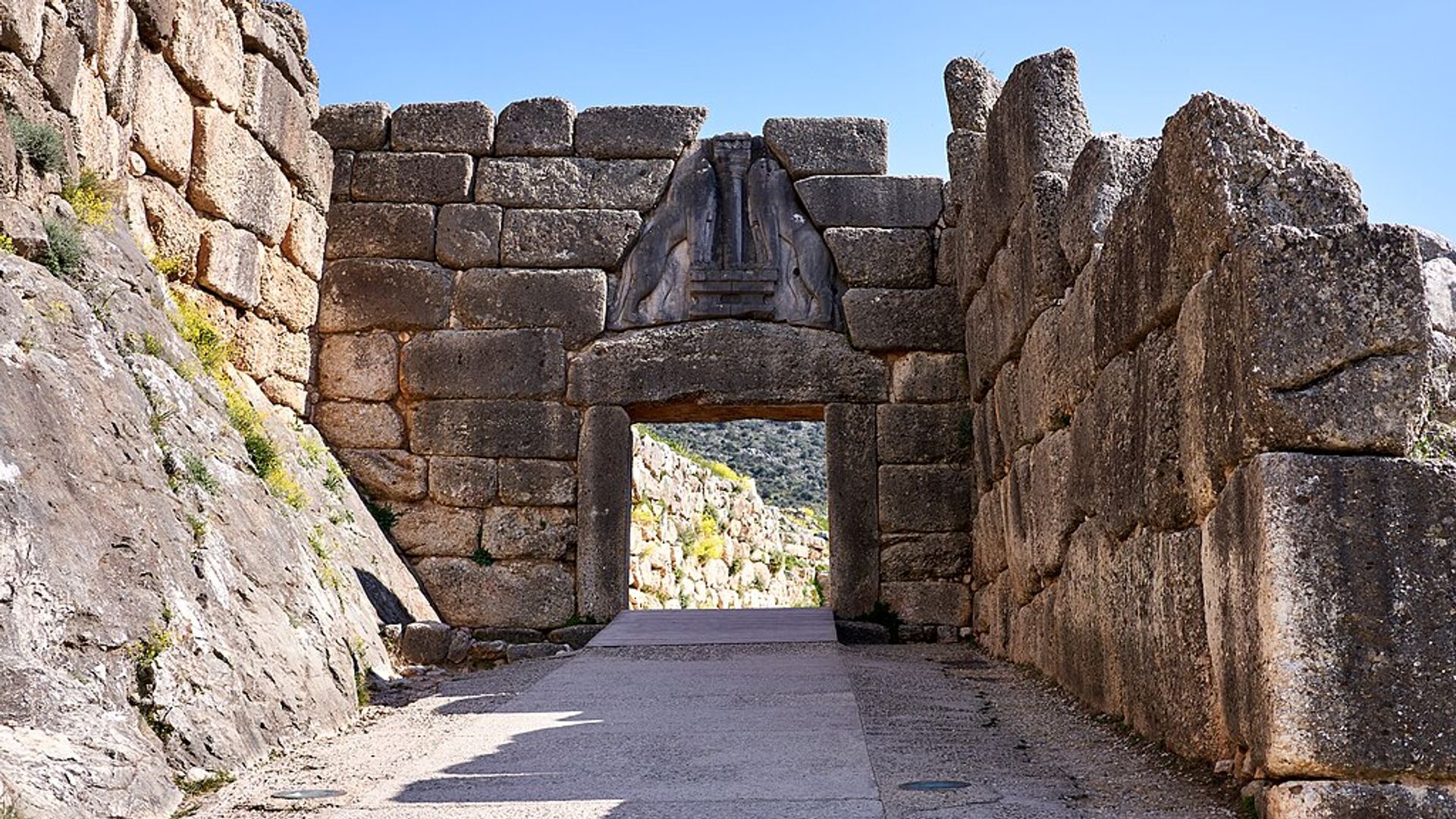
The Lion Gate of Mycenae stands as one of the most recognizable symbols of ancient Greek civilization, welcoming visitors through its monumental threshold for over 3,200 years. This architectural masterpiece combines military engineering with artistic brilliance, featuring Europe's oldest known monumental sculpture.
Standing before the Lion Gate of Mycenae, you're not just looking at ancient stones—you're gazing at the same entrance that Bronze Age warriors, merchants, and kings passed through more than three millennia ago. This massive gateway, crowned by two powerful lions carved in stone, represents the pinnacle of Mycenaean architectural achievement and continues to inspire awe in every traveler who makes the journey to this legendary citadel.
The Lion Gate isn't merely an entrance; it's a statement of power, artistry, and engineering prowess that has survived earthquakes, invasions, and the passage of time. As you approach this iconic monument, you'll understand why it has become one of the most photographed and studied ancient structures in all of Greece.
The Magnificent Architecture of the Lion Gate
Constructed around 1250 BCE, the Lion Gate served as the main entrance to the fortified citadel of Mycenae during the height of Mycenaean civilization. The structure stands approximately 3.10 meters high and 2.95 meters wide at its base, creating an imposing threshold that would have intimidated enemies while welcoming allies.
The gateway's construction demonstrates remarkable engineering sophistication for the Bronze Age. Four massive limestone blocks form the doorposts and lintel, with the largest lintel stone weighing an estimated 20 tons and measuring about 4.5 meters in length.
Architectural Features:
- Cyclopean masonry walls extending on both sides of the gate
- Relieving triangle above the lintel to distribute weight
- Original wooden door posts that once supported massive doors
- Threshold stone showing wear marks from ancient chariot wheels
- Carefully fitted megalithic blocks requiring no mortar
The famous relief sculpture sits within the relieving triangle, depicting two lionesses (their heads, likely made of bronze or steatite, are now missing) flanking a central column. This relief represents the oldest known monumental sculpture in Europe, making it an invaluable piece of artistic heritage.
The Symbolism Behind the Lions
The twin lions weren't chosen randomly—they carried profound meaning for Mycenaean society. The lionesses stand in a heraldic pose, their front paws resting on altars that flank a distinctive Minoan-style column, creating a composition rich with religious and political significance.
Scholars believe the lions symbolized the power and authority of the Mycenaean kings who ruled from this fortress. The column between them likely represents a sacred pillar or the palace itself, suggesting divine protection over the royal household and the entire citadel.
Symbolic Interpretations:
- Royal power and military might of Mycenaean rulers
- Divine protection from guardian deities
- Connection to the goddess Potnia Theron (Mistress of Animals)
- Intimidation factor for approaching enemies
- Religious significance linking earthly and divine authority
The choice of lions is particularly interesting given that lions were not native to Bronze Age Greece, though they did inhabit the region in earlier periods. This exotic imagery would have enhanced the gate's impressive and somewhat mysterious character, much like the civilization's legendary architectural achievements found throughout the region.
Historical Context and Discovery
While the Lion Gate never completely disappeared from view—it remained partially visible throughout the centuries—its full archaeological significance wasn't recognized until Heinrich Schliemann's excavations in the 1870s. The German archaeologist, driven by his belief in Homer's epics, uncovered the treasures of Mycenae and brought the Lion Gate back into the spotlight of world attention.
The gate dates to the final phase of the citadel's fortification, constructed during the reign of the last great Mycenaean rulers. This period, known as Late Helladic IIIB (approximately 1250-1200 BCE), saw Mycenae at its peak power and influence across the Aegean world.
Historical Timeline:
- 1250 BCE: Construction of the Lion Gate and citadel expansion
- 1200-1100 BCE: Decline of Mycenaean civilization
- 468 BCE: Mycenae destroyed by Argos
- 2nd century CE: Pausanias describes the gate in his travels
- 1876: Schliemann's major excavations begin
- 1999: UNESCO World Heritage Site designation
The gate witnessed the final glory days of Mycenaean civilization before the mysterious collapse of Bronze Age cultures across the Mediterranean. Understanding this context adds layers of meaning to your visit, connecting you to one of history's most intriguing periods.
Quick Facts About the Lion Gate
Essential Information:
- Age: Approximately 3,250 years old (built circa 1250 BCE)
- Height: 3.10 meters (10.2 feet)
- Width: 2.95 meters (9.7 feet) at base
- Lintel Weight: Approximately 20 tons
- Relief Size: 3 meters wide, 1 meter high
- Material: Limestone blocks with conglomerate relief
- Construction Method: Cyclopean masonry
- Status: UNESCO World Heritage Site (part of Mycenae)
The term "Cyclopean masonry" refers to the massive, irregularly shaped stones used in construction. Ancient Greeks believed only the mythical Cyclopes could have moved such enormous blocks, giving rise to the name that's still used today.
Visiting the Lion Gate Today
The Lion Gate forms part of the larger archaeological site of Mycenae, located in the northeastern Peloponnese about 120 kilometers southwest of Athens. The site sits on a rocky hill between two peaks, offering commanding views of the Argolid plain—a strategic position that explains why this location was chosen for such an important citadel.
Modern visitors enter through the same gate that ancient Mycenaeans used, creating an immediate and powerful connection to the past. The experience of walking beneath those carved lions, treading on stones worn smooth by countless footsteps over millennia, ranks among the most memorable moments any traveler can have in Greece.
What to See at the Site:
- The Lion Gate entrance and fortification walls
- Grave Circle A with its royal shaft graves
- The Palace complex on the summit
- Underground cistern and secret passages
- Treasury of Atreus (nearby, separate entrance)
- Museum displaying artifacts from excavations
Many travelers combine their visit to Mycenae with nearby ancient Epidaurus, creating a perfect day of exploring Bronze Age and Classical Greek heritage. The two sites complement each other beautifully, offering different perspectives on ancient Greek civilization.
Planning Your Visit: Practical Travel Tips
Timing your visit correctly can dramatically enhance your experience at the Lion Gate. The site can become crowded during peak summer months, and the exposed hilltop offers little shade during the intense midday heat.
Best Times to Visit:
- Early morning (8:00-10:00 AM) for cooler temperatures and better light
- Late afternoon (4:00-6:00 PM) for golden hour photography
- Spring (April-May) or autumn (September-October) for pleasant weather
- Weekdays rather than weekends to avoid crowds
- Avoid July-August midday when temperatures exceed 35°C
What to Bring:
- Sturdy walking shoes with good grip (terrain is uneven)
- Sun protection (hat, sunscreen, sunglasses)
- Water bottle (at least 1 liter per person)
- Camera with charged batteries
- Light layers for variable temperatures
- Walking stick if you have mobility concerns
The path from the entrance to the Lion Gate involves some uphill walking on ancient, irregular stone surfaces. While not extremely strenuous, it does require reasonable mobility and balance, especially when navigating the areas beyond the gate within the citadel.
Getting to Mycenae from Major Cities
Mycenae's location in the Argolid makes it accessible from several major Greek destinations. The charming town of Nafplio, often considered one of Greece's most beautiful cities, serves as an ideal base for exploring the region.
Transportation Options:
- From Athens: 120 km, approximately 1.5-2 hours by car
- From Nafplio: 25 km, approximately 30 minutes by car
- From Corinth: 50 km, approximately 45 minutes by car
- From Kalamata: 150 km, approximately 2 hours by car
Public transportation to Mycenae exists but is limited and time-consuming. Most visitors either rent a car or book organized tours that include transportation, which provides the advantage of expert commentary and hassle-free logistics.
Our Nafplio Mycenae and Epidaurus tour offers a comprehensive exploration of the region's most important archaeological sites with knowledgeable local guides who bring the ancient stones to life with fascinating stories and historical context.
Beyond the Gate: Exploring the Citadel
Once you pass through the Lion Gate, the entire fortified citadel opens before you. The path leads upward through the ancient city, passing the royal burial ground known as Grave Circle A, where Schliemann discovered the famous gold "Mask of Agamemnon" and other spectacular treasures.
The palace complex at the summit rewards the climb with panoramic views across the Argolid plain. From this vantage point, you can understand the strategic importance of Mycenae's location and imagine the kingdom that once controlled trade routes throughout the region.
Key Areas Within the Citadel:
- Grave Circle A: Royal burial ground with six shaft graves
- Palace Megaron: Throne room and ceremonial center
- Cult Center: Religious buildings and shrines
- Artisans' Quarters: Workshops and storage areas
- Underground Cistern: Ingenious water supply system
- North Gate: Secondary entrance with postern gate
The underground cistern deserves special mention as an engineering marvel. Descending into this cool, dark passage cut through solid rock, you'll appreciate the sophisticated infrastructure that supported life in this Bronze Age fortress.
The Lion Gate in Greek Mythology and Literature
Mycenae occupies a central place in Greek mythology as the kingdom of Agamemnon, leader of the Greek forces in the Trojan War. While the Lion Gate postdates the legendary Trojan War by several centuries, it became inextricably linked with these epic stories in the Greek imagination.
The ancient travel writer Pausanias, visiting in the 2nd century CE, described the Lion Gate in his "Description of Greece," noting both the gateway and the legendary graves of Agamemnon and his companions. His account helped preserve knowledge of the site through the medieval period and into modern times.
Literary Connections:
- Homer's Iliad and Odyssey reference Mycenae's wealth
- Aeschylus's Oresteia trilogy set in Mycenae's palace
- Euripides's plays featuring Electra and Orestes
- Pausanias's travel guide preserving ancient traditions
- Modern literature and poetry inspired by the ruins
These mythological associations add another dimension to visiting the Lion Gate. Standing at this threshold, you're not only touching Bronze Age history but also entering the legendary world of Greek epic poetry and tragedy, where fascinating aspects of ancient Greek culture come alive.
Photography Tips for the Lion Gate
The Lion Gate presents wonderful photographic opportunities, but capturing its majesty requires some consideration of angles, lighting, and timing. The relief sculpture faces west, meaning morning light illuminates it from the side, while afternoon sun hits it more directly.
Photography Recommendations:
- Shoot from slightly below to emphasize the gate's imposing height
- Include people in frame to show scale of the massive stones
- Capture details of the lion relief with a telephoto lens
- Use wide angle for the full gate within the Cyclopean walls
- Early or late light creates dramatic shadows and texture
- Black and white photography emphasizes the timeless quality
Avoid midday harsh light which flattens the relief details and creates unflattering shadows. The golden hours of early morning and late afternoon provide the most atmospheric lighting for both the gate and the wider citadel views.
Combining Mycenae with Other Peloponnese Attractions
The Argolid region surrounding Mycenae offers numerous other compelling destinations that combine beautifully into multi-day itineraries. The compact geography means you can experience diverse aspects of Greek history and culture without extensive driving.
Nearby Nafplio serves as the perfect base, offering excellent restaurants where you can enjoy authentic Greek dining after a day of archaeological exploration. This Venetian-influenced town provides a complete contrast to the Bronze Age ruins, showcasing later periods of Greek history.
Nearby Attractions:
- Ancient Epidaurus and its famous theater (30 km)
- Nafplio old town and Palamidi Fortress (25 km)
- Ancient Corinth and Acrocorinth (50 km)
- Nemea archaeological site and wineries (35 km)
- Tiryns cyclopean fortress (15 km)
- Argos and its ancient theater (12 km)
For those interested in exploring the broader Peloponnese region, consider our Nafplio to Sparta and Mystras tour, which extends your Bronze Age experience into the Byzantine period while passing through stunning mountain scenery.
Conservation and Preservation Efforts
The Lion Gate has survived remarkably well considering its age, but ongoing conservation work ensures it will endure for future generations. The Greek Ministry of Culture, in collaboration with international organizations, monitors the site continuously and implements necessary preservation measures.
Recent conservation efforts have focused on stabilizing the Cyclopean walls, managing water drainage to prevent erosion, and protecting the relief sculpture from environmental damage. Visitors play a role in preservation by following site rules and treating these ancient monuments with appropriate respect.
Visitor Responsibilities:
- Stay on designated paths to prevent erosion
- Don't touch or climb on ancient structures
- Avoid using flash photography on the relief
- Remove all trash and recyclables from the site
- Follow guide instructions regarding restricted areas
- Report any damage or concerns to site officials
The designation of Mycenae as a UNESCO World Heritage Site in 1999 (along with nearby Tiryns) recognized its outstanding universal value and strengthened international commitment to its preservation. This status ensures that resources and expertise continue flowing toward maintaining this irreplaceable cultural treasure.
The Lion Gate's Influence on Later Architecture
The Lion Gate's architectural and artistic innovations influenced subsequent Greek building traditions in subtle but significant ways. The use of relieving triangles became a standard technique in later Greek architecture, appearing in various forms throughout the classical and Hellenistic periods.
The heraldic composition of the lion relief—two animals flanking a central element—established a pattern that recurred throughout Greek and later European art and architecture. You'll recognize echoes of this design in countless coats of arms, building decorations, and monumental gateways across the centuries.
Architectural Legacy:
- Relieving triangle technique adopted in later Greek building
- Heraldic composition influencing decorative arts
- Monumental gateway concept in civic architecture
- Integration of sculpture with structural elements
- Symbolic use of animals representing power and protection
Modern architects and artists continue drawing inspiration from the Lion Gate's powerful simplicity and enduring presence. Its image appears in countless books, films, and artistic works, serving as a universal symbol of ancient Greek civilization's achievements.
Frequently Asked Questions
How long does it take to visit the Lion Gate and Mycenae?
A thorough visit to the archaeological site of Mycenae, including the Lion Gate, citadel, and museum, typically requires 2-3 hours. If you're particularly interested in archaeology or photography, allow 3-4 hours to explore at a leisurely pace without feeling rushed. The site involves uphill walking on uneven terrain, so factor in rest breaks, especially during warm weather.
Can you actually walk through the Lion Gate?
Yes, visitors walk through the Lion Gate just as ancient Mycenaeans did over 3,000 years ago. This is one of the most thrilling aspects of visiting the site—experiencing the same entrance used by Bronze Age inhabitants. However, you must stay on designated paths and cannot touch the relief sculpture or climb on the ancient stones, as these conservation measures protect the monument for future generations.
What's the best way to reach Mycenae without a car?
Public buses run from Athens and Nafplio to the modern village of Mycenae, but schedules are limited and the bus stop is about 1 kilometer from the archaeological site entrance. The most practical options without a car are organized tours or hiring a taxi for the day. Tours offer the advantage of expert guides who provide historical context that dramatically enriches the experience, making the ancient stones come alive with stories and significance.
Is Mycenae suitable for children and families?
Mycenae can be excellent for families with children, though it depends on the children's ages and interests. The Lion Gate itself usually captivates young imaginations, and the mythological connections to stories of Agamemnon and the Trojan War engage older children. However, the site requires walking on uneven ancient stones, which may challenge very young children or those in strollers. The exposed hilltop offers little shade, so bring sun protection and plenty of water for the whole family.
Are there facilities like restrooms and cafes at Mycenae?
The archaeological site entrance area has restrooms, a small café, and a gift shop. However, once you enter the site itself, no facilities exist within the ancient citadel. The modern village of Mycenae, about 1 kilometer away, offers several restaurants and cafes where you can enjoy a meal before or after your visit. Plan accordingly by using facilities before entering the site and bringing water, especially during summer months.
What's the connection between the Lion Gate and the Trojan War?
The Lion Gate was built around 1250 BCE, while the legendary Trojan War, if historical, likely occurred somewhat earlier, around 1300-1200 BCE. However, Mycenae was certainly the most powerful kingdom in Greece during this period, lending credence to Homer's depiction of Agamemnon, king of Mycenae, as leader of the Greek forces. While we can't prove the specific individuals from mythology existed, the Lion Gate represents the real power and wealth of the civilization that inspired these epic stories.
How does Mycenae compare to other ancient Greek sites?
Mycenae offers a unique experience distinct from classical Greek sites like the Acropolis or Delphi. It's significantly older, dating to the Bronze Age rather than the Classical period, and showcases different architectural styles—massive Cyclopean masonry rather than refined marble columns. The site feels more rugged and mysterious, with a darker, more martial character reflecting its fortress nature. Many visitors find Mycenae more atmospheric and evocative than better-preserved but more heavily visited classical sites.
Can you visit the Treasury of Atreus on the same ticket?
Yes, the admission ticket to the Mycenae archaeological site includes entry to the Treasury of Atreus (also called the Tomb of Agamemnon), located about 400 meters down the road from the main site. This spectacular beehive tomb represents another architectural masterpiece of Mycenaean civilization and shouldn't be missed. Most visitors see the Treasury either before or after exploring the citadel and Lion Gate, as it's easily accessible and takes about 20-30 minutes to visit.
Conclusion: Why the Lion Gate Matters Today
The Lion Gate of Mycenae transcends its function as an ancient entrance to become a powerful symbol connecting us to humanity's distant past. Standing before this monument, you're witnessing the achievements of a civilization that flourished when writing was rare, iron was unknown, and the classical Greek world lay centuries in the future.
This gateway represents more than architectural skill or artistic achievement—it embodies the human drive to create lasting monuments that proclaim power, inspire awe, and endure through ages. The fact that we can still walk through this entrance, our footsteps joining countless others across 3,250 years, creates a profound connection to the continuous thread of human civilization.
Whether you're a history enthusiast, archaeology buff, mythology lover, or simply a curious traveler, the Lion Gate offers an unforgettable encounter with the ancient world. Its weathered stones and guardian lions stand as testimony to the sophistication, ambition, and artistry of Bronze Age Greece, inviting each new generation to discover and marvel at this extraordinary heritage.
Plan your visit to this remarkable monument and experience firsthand why the Lion Gate of Mycenae continues to captivate imaginations and inspire wonder more than three millennia after its construction.